Why FarmHQ Is Offline-First, Not Tolerant
Most software treats a dropped connection as an edge case to handle gracefully. We treat it as the normal condition to design for, because on a working farm, it usually is.
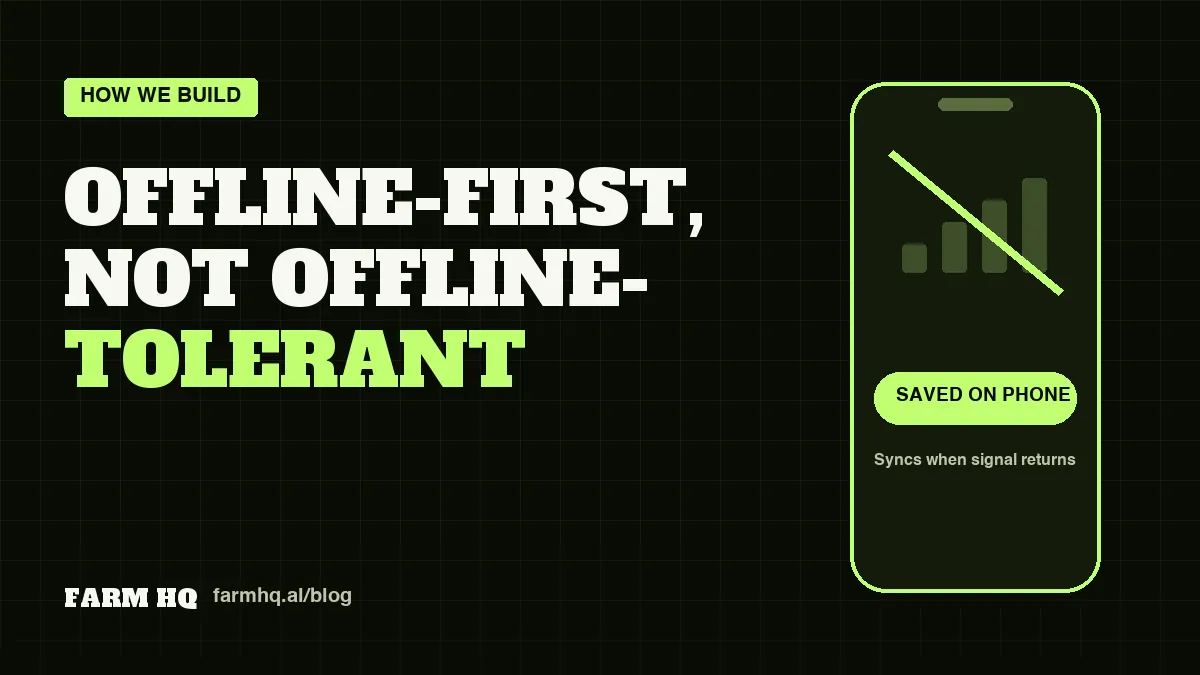
Most software treats a dropped connection as an edge case to handle gracefully. We treat it as the normal condition to design for, because on a working farm, it usually is.
FarmHQ is offline-first: a record saves to an on-device database the instant it is entered, whether typed or spoken, with no dependency on a live connection, and syncs to the cloud automatically once signal returns. In our own farmer research, 76% of respondents reported signal blackspots somewhere on their holding, often in exactly the places records get made, so offline-tolerant, an app that assumes connectivity and copes when it drops, is not the same standard, and it is not good enough.
The distinction sounds like a technicality until you actually use the two kinds of app side by side. Offline-tolerant software is built assuming a connection exists, and when it doesn't, the app tries to cope: a queued request, a retry loop, sometimes a quiet failure the user only discovers later when a record they thought they'd saved is nowhere to be found. Offline-first software is built the other way round. It assumes no connection by default, writes every record to the device first, and treats the sync to the cloud as a background task that happens when it can, not a precondition for the record existing at all.
That single design decision, made once at the start, shapes almost everything else about how the app behaves. It is the difference between "this should still work without signal" as an afterthought bolted onto an already-built product, and "this has no reason not to work" as the starting assumption underneath every screen.
The blackspots that show up in that number are not random either. They cluster in exactly the places a farm record actually gets made: the calving pen at the back of a stone barn, the handling shed with metal on three sides, the far side of a hill field where the nearest mast is a memory. These are not unlucky edge cases a product can shrug off, they are core, ordinary, Tuesday-afternoon working conditions for a large share of the people this app is built for. A farm app that only works reliably in the farmhouse kitchen, where the wifi is, has quietly failed at the actual job.
The interface consequence matters as much as the underlying architecture. A record entered with no signal shows a plain-English state, saved on phone, will sync, immediately, not a spinner that could mean anything from "working on it" to "this has failed silently." Ambiguity here is the real enemy. A farmer who cannot tell whether a movement or a medicine-book entry actually saved has every reason to distrust the app entirely, and rightly so, since a compliance record that might not exist is worse than no record at all if it creates false confidence.
When evaluating any farm software, don't take "works offline" at face value from the marketing copy. Put the phone in airplane mode, log a record, and see what the screen actually tells you. If it's ambiguous about whether the record saved, it is offline-tolerant at best, not offline-first.
Being honest about this: offline-first is harder to build than offline-tolerant, and it stays harder for the life of the product. Every screen that writes data needs a strategy for what happens if two devices edit the same record while both are offline and then both come back online. Every sync needs to resolve conflicts sensibly rather than silently picking a winner. It would be genuinely simpler, from an engineering point of view, to require a live connection and let the app be honest about that limitation. We chose not to, because the alternative is a farmer standing in a field they cannot get signal in, needing to log something before they forget it, and being told to try again later.
This is also why offline-first cannot really be added to a product later as a feature update. Retrofitting it means reworking how every existing screen saves data, how conflicts get resolved, how the app reports its own state back to the user, changes that touch the entire architecture rather than one corner of it. Building it in from the start, alongside the same design thinking behind 56dp touch targets for gloved hands and dark mode as a first-class option for a 6am yard, was the only way to make the promise credible rather than aspirational.
It also shapes how we ship fixes. FarmHQ's mobile app updates over the air rather than waiting on an app-store review cycle, so a bug in how a specific sync conflict gets resolved can go out the same day it's found, not weeks later. That matters more for offline-first software than for most apps, because the sync layer is exactly the part of the system most likely to meet an edge case nobody anticipated, a farm with three phones logging the same herd from three different fields at once, say, and the ability to correct that quickly rather than leaving it broken until the next scheduled release is part of what makes offline-first trustworthy in practice, not just in the architecture diagram.
Whether you're stood in the calving pen, the top field, or the kitchen with full bars, FarmHQ behaves the same way: the record saves the instant you make it, and syncs whenever the signal allows. Joe drafts, you confirm, and neither step is ever waiting on a mobile mast.
See how FarmHQ worksIt means a record saves to the device instantly the moment it is entered, with no dependency on a live connection, and syncs to the cloud automatically once signal returns. Offline-tolerant, by contrast, means an app that assumes connectivity but degrades gracefully when it drops, which is a lower and less reliable standard.
In FarmHQ's own farmer research, 76% of respondents reported signal blackspots somewhere on their holding, often in exactly the places records get made: calving pens, handling sheds, the far side of a hill field.
You should not have to guess. FarmHQ shows a plain-English state, saved on phone, will sync, the moment a record is entered with no signal, rather than a spinner or a blank screen that leaves it unclear whether anything actually happened.
Retrofitting offline behaviour onto software built assuming connectivity means reworking how every screen saves data, handles conflicts, and reports its own state, changes that touch the entire architecture rather than one feature. Building it in from day one is a different, and far more reliable, starting point.